The uvm_object class
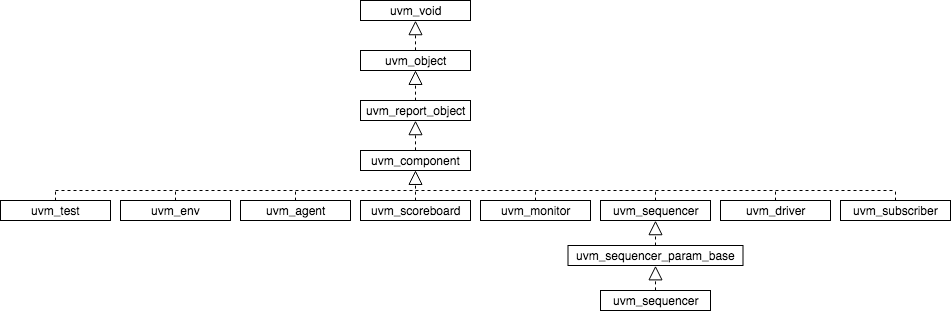
The uvm_object class is the base class for all UVM classes. From it, all the rest of classes are extended. It provides basic functionalities such as …

The uvm_object class is the base class for all UVM classes. From it, all the rest of classes are extended. It provides basic functionalities such as …
\[ s_k = (k\cdot A) \bmod B\]
\(s_k\) is the pseudo-random number and \(A\) and \(B\) are prime numbers. \(k\) is in the range \(
\[0,B-1\]\). If …
Let’s z be a 2D point in the space as \(z = x + jy\), if we want to rotate this point a given angle \(\theta\), we get the following …
| |
Example:
|
UVM introduces the concept of phases to ensure that all objects are properly configured and connected before starting the runtime simulation. Phases …
To use UVM in your Verilog test bench, you need to compile the UVM package top. To do so, you need to include it on your file by using:
|
When an operation such as an addtion or a substraction is done using different size operands than final variable, it is necessary to extend sign to …
Onda estacionaria creada por dos ondas viajeras.